
COPENHAGEN – Danish scientists have created wildlife tracking collars that power themselves using animal movement. These revolutionary devices could last an entire animal’s lifetime without needing new batteries. The breakthrough technology helps scientists study hard-to-find animals for years without disturbing them.
The research team from Denmark’s Natural History Museum at the University of Copenhagen tested their self-powered collars on pet dogs, wild horses, and European bison. One device worked continuously for 147 days and was still operating when the study ended. The technology works like automatic watches, turning every step and movement into electrical power.
Battery Failure End Most Animal Studies
Wildlife scientists have faced the same problem for many years: tracking devices stop working before research projects finish. Traditional GPS collars use lithium batteries that companies say last for decades. However, real field studies show batteries often fail early because of extreme hot and cold temperatures.
Wildlife tracking devices must be very light to avoid hurting animals. Scientists follow a rule that tracking collars should weigh no more than 3-5% of an animal’s body weight. This weight limit makes it difficult to use large batteries on smaller animals. Even larger animals have problems when batteries fail in harsh weather conditions.
Some researchers use solar panels to extend battery life, especially for tracking birds. But solar panels have major limitations. Many animals live in dark places like thick forests or caves. Other animals are active at night when there is no sunlight. Animals like pandas, tigers, and sea lions cannot use solar-powered trackers effectively.
How the New Technology Works
The Kinefox system uses the same idea as automatic watches that wind themselves when people move their wrists. Inside each collar, scientists placed a small generator that weighs only 18 grams and measures 32 millimeters across. This generator comes from a commercial smartwatch and converts animal movement into electrical power.
The generator contains a pendulum with a magnetic ring placed around copper wire coils. When animals move, the pendulum swings back and forth. The magnetic ring creates electrical current in the copper wire through a process called electromagnetic induction. Special circuits change this electricity into the right type of power for the tracking system.
Instead of regular batteries, the researchers chose a special hybrid supercapacitor for energy storage. Most lithium batteries can be charged and used only 300-500 times before they stop working well. The new supercapacitor can be charged and used 20,000 times, making it last much longer than regular batteries.
Real-World Testing Shows Good Results
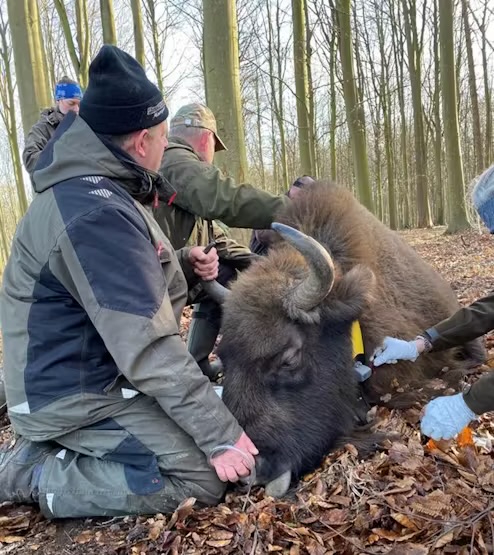
Lead scientist Rasmus Worsøe Havmøller from Copenhagen’s Natural History Museum tested the devices on different animals. One pet dog generated up to 10.04 joules of energy per day, while a wild Exmoor pony generated an average of 0.69 joules daily. A European bison generated 2.38 joules per day on average.
The complete tracking device and collar weigh only 150 grams (about 5.3 ounces). This makes the collar light enough for animals as small as 3 kilograms to wear safely. The amount of energy generated depends heavily on how much and how fast animals move.
Different animals create different amounts of energy based on their size, body shape, and movement patterns. This makes it difficult to predict which animals will work best with kinetic-powered trackers. Researchers found that the placement and mounting of the device also affects how much energy it can generate.
Technology Helps Study Rare Asian Wild Dogs
The research began partly because Havmøller wanted to study endangered Asian wild dogs called dholes. Fewer than 2,000 of these small-headed, long-bodied dogs remain in the wild. Watching the dogs run across the dry grasslands of southern Asia made scientists wonder if they could convert that running energy into electrical power.
Many wildlife trackers use solar power, but this does not work for night-active animals or animals living in dark places. Animals that live underwater, in thick forests, or in caves cannot use solar-powered trackers. This limitation makes kinetic energy harvesting especially valuable for studying species that are both rare and difficult to observe.
The system sends data using Sigfox, a special wireless network designed for devices that need very little power. Researchers chose Sigfox because it uses very little energy, works easily with their equipment, and has coverage in Denmark and Germany where they conducted their tests.
Device Works for Months Without Human Help
The most impressive test involved an Exmoor pony that roamed freely in Denmark. After 12 days, the device began collecting GPS location data and movement information once per day. The system successfully obtained 27 GPS fixes, with each location taking an average of 59.56 seconds to determine.
The tracker continued working for 147 days after scientists attached it to the pony. Even after this long period, the device continued to wake up and send GPS locations every 4 to 24 days, depending on how much energy the pony’s movement generated. This demonstrates the system’s ability to operate for months without any human interference.
Scientists Share Design for Free
The Danish research team made their complete design available for free to help other scientists adopt the technology faster. All design files for both versions of the Kinefox tracker, plus a complete list of components, are available as open-source downloads on GitHub. This approach allows other wildlife research teams to build and modify the technology for their specific research needs.
The researchers hope others will improve their work to create even more efficient devices that weigh less. Future improvements could include optimizing the energy harvester for different animal movement patterns and reducing weight so smaller species can use the technology.
Technology Still Faces Some Challenges
Despite its promise, the technology has several limitations that researchers openly acknowledge. The energy generator contains moving parts, and all moving parts wear out over time. During testing, one magnetic ring broke inside a device, showing that durability needs more investigation.
The current design focused on making the device strong and durable rather than as light as possible. Researchers believe there is great potential to reduce weight significantly for use on smaller animals or in ear-tag designs. Weight reduction could make the technology suitable for many more animal species.
Researchers also discovered that the placement of the device is very important. The ideal mounting position varies from species to species and should be optimized for each type of animal. Since animal species differ greatly in size, shape, and movement patterns, more research is needed to determine the best configurations.
Important Benefits for Wildlife Protection
This technology arrives at an important time for wildlife conservation when understanding animal behavior is essential for protecting endangered species. Scientists say that lifetime tracking could help them understand juvenile dispersal, which is often the least understood but most critical phase for understanding survival and how movement behaviors develop in mammals.
The technology could be a major advancement for tracking larger animals because long-lasting power sources mean less human interaction with wildlife. The devices work day or night in virtually any environment, making them extremely versatile for different research situations.
The system shows particular promise for studying animals that travel very long distances. When studying animals that move hundreds or thousands of kilometers, scientists do not always need precise GPS locations. European wolves can travel over 3,000 kilometers, while red foxes can travel more than 1,000 kilometers during their lifetimes.
Future Impact on Wildlife Research
The Kinefox represents a significant step forward in wildlife tracking technology. It offers the possibility of truly lifetime animal monitoring without the environmental and financial costs of repeatedly replacing devices. Scientists would no longer need to recapture animals to change batteries, reducing stress on wildlife populations.
As the technology continues to improve and costs decrease, self-powered wildlife tracking may become the standard approach for studying animal behavior around the world. The combination of reduced environmental impact, lower long-term costs, and dramatically improved data quality makes this innovation important for wildlife research capabilities.
The success of this Danish innovation could influence how scientists study animal behavior and ecology for many years to come. By solving one of wildlife research’s biggest technical challenges, these self-powered trackers open new possibilities for understanding and protecting wildlife populations worldwide.
Key Takeaways
- Breakthrough Technology: Danish scientists at the University of Copenhagen’s Natural History Museum created wildlife trackers that power themselves using animal movement, potentially lasting an animal’s entire lifetime without battery replacement.
- Real-World Success: Field tests on domestic dogs, Exmoor ponies, and European bison showed the Kinefox system can operate for months, with one device still functioning after 147 days of continuous use.
- Conservation Impact: The technology published in PLOS ONE journal could revolutionize wildlife research by enabling lifetime tracking of endangered species like dholes without repeated human interference or environmental disruption.
Learn More
- German Researchers Perfect Thermal Energy Harvesting Wildlife Trackers – Discover how scientists in Germany use body heat differences to power animal tracking devices continuously.
- AI Camera Traps Identify Individual Leopards in Tanzania’s Udzungwa Mountains – Learn how artificial intelligence helps researchers track specific big cats without physical collars or tags.
- Sigfox IoT Network Transforms African Wildlife Monitoring Across Multiple Countries – Explore how low-power wireless networks enable real-time wildlife tracking across vast African conservation areas.