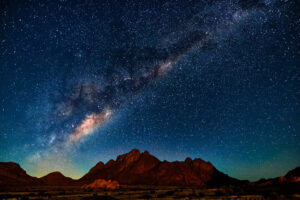
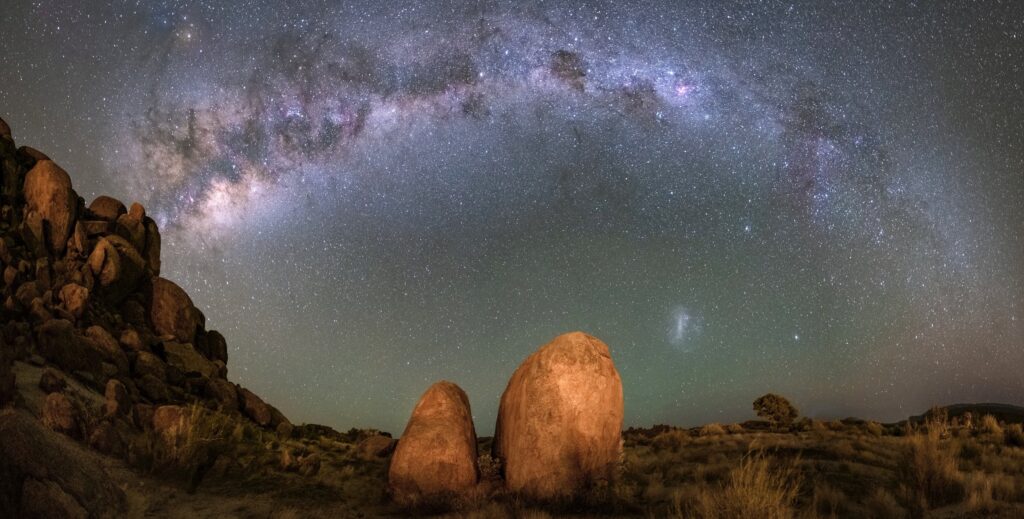
SOSSUSVLEI, NAMIBIA – Deep in southern Africa’s ancient Namib Desert lies one of the darkest accessible places on Earth, where tourists can see thousands of individual stars and watch the Milky Way stretch across an unpolluted sky. The NamibRand Nature Reserve earned prestigious Gold Tier certification as an International Dark Sky Reserve in 2012, making it Africa’s first protected stargazing sanctuary.
This vast desert wilderness offers Bortle Class 1-2 sky conditions, meaning almost zero light pollution interferes with astronomical observations. Scientists measure the night sky darkness here using specialized equipment, with readings consistently showing some of the darkest skies measured anywhere on the planet. The combination of extreme isolation, dry climate, and minimal human development creates perfect conditions for viewing celestial wonders invisible to most of humanity.
What Makes Namib Desert Skies Special
The Namib Desert’s exceptional darkness comes from its unique combination of geographic and environmental factors. This ancient desert, estimated to be 55 million years old, covers approximately 31,200 square miles of southwestern Namibia with virtually no permanent human settlements. The nearest communities are small towns located more than 60 miles away from the core stargazing areas.
The desert receives less than 8 inches of rainfall annually and maintains extremely dry air throughout most of the year. This lack of atmospheric moisture means starlight travels through the air without being scattered or absorbed, allowing even faint celestial objects to shine clearly. Professional astronomers consider these conditions ideal because atmospheric interference is minimal, especially for objects near the horizon that would be difficult to see in other locations.
Light pollution measurements taken with Sky Quality Meters consistently show readings that place the NamibRand Nature Reserve among the darkest locations ever recorded. On moonless nights, visitors can see thousands of individual stars with the naked eye, compared to only a few dozen stars visible from typical urban areas where most people live.
Sossusvlei Offers Premium Stargazing Experience
Sossusvlei, located within the Namib-Naukluft National Park, serves as the primary destination for astronomy tourism in the region. This area features the famous red sand dunes that can reach heights of 1,000 feet, creating dramatic landscapes during the day and providing elevated viewing platforms for night sky observations.
The andBeyond Sossusvlei Desert Lodge operates a professional observatory equipped with a 12-inch Meade LX200 telescope and employs a resident astronomer to guide visitors through their stargazing experiences. The lodge modified its lighting systems to meet International Dark Sky Reserve requirements, using only red-filtered lights that preserve night vision and installing skylights in guest rooms so visitors can fall asleep while viewing the stars.
Professional astronomy tours in the area use computerized telescopes with tracking software to locate distant galaxies, planetary nebulae, and other deep-space objects up to 60 million light-years away. The stable atmospheric conditions allow for detailed observations of Saturn’s rings, lunar craters, and the intricate structure of nearby galaxies and nebulae.
Southern Hemisphere Celestial Highlights
The Namib Desert’s location in the Southern Hemisphere provides access to celestial objects and constellations that cannot be seen from most northern locations. Visitors can observe the Southern Cross constellation, the Centaurus region, and the spectacular Scorpius constellation with remarkable clarity.
One of the most impressive sights visible from the Namib is the Large and Small Magellanic Clouds, which are small galaxies that orbit our own Milky Way. These appear as bright, cloud-like patches in the night sky and are easily visible to the naked eye under the desert’s dark conditions. From light-polluted areas, these galaxies are completely invisible.
The zodiacal light, one of the most elusive astronomical phenomena, appears regularly in the Namib’s pristine skies. This faint, triangular glow extends upward from the horizon after sunset and before sunrise, created by sunlight reflecting off microscopic dust particles throughout our solar system. In extremely dark conditions, observers can sometimes see an even rarer phenomenon called the gegenschein, a faint brightening of the zodiacal light directly opposite the sun.
The Science Behind Bortle Scale Measurements
Astronomers use the Bortle Dark Sky Scale to measure how much light pollution affects different locations. This nine-level scale ranges from Class 1 (the darkest possible skies) to Class 9 (heavily light-polluted urban areas). The Namib Desert consistently measures as Bortle Class 1-2, placing it among the darkest locations accessible to tourists worldwide.
At Bortle Class 1 sites like the NamibRand Nature Reserve, the Milky Way appears so bright that it can cast shadows on the ground. Observers can see the galaxy M33 in the Triangulum constellation with direct vision rather than requiring peripheral vision techniques needed in less dark locations. The contrast between dark sky areas and the bright star clouds of the Milky Way becomes dramatically apparent.
Sky Quality Meter readings in the NamibRand Nature Reserve regularly exceed 21 magnitudes per square arcsecond, with the theoretical maximum darkness measuring 22. For comparison, urban areas typically measure between 16-17, meaning the Namib Desert skies are more than 100 times darker than city skies where most people live.
International Recognition and Protection Efforts
The International Dark-Sky Association granted the NamibRand Nature Reserve Gold Tier International Dark Sky Reserve status in May 2012, making it only the second location worldwide to achieve this highest certification level. Dr. George Tucker, a retired physics professor from the United States, led the certification effort after identifying the area’s exceptional astronomical potential.
The designation requires strict lighting controls throughout the 772-square-mile reserve. All outdoor lighting must be shielded to prevent light from escaping upward, and many unnecessary lights have been completely eliminated. These measures protect both the dark sky environment and the nocturnal wildlife that depends on natural darkness for hunting, mating, and migration behaviors.
The Namib Desert Environmental Education Trust operates an educational center within the reserve, teaching visitors about astronomy and light pollution prevention. The center offers overnight programs where guests, particularly school groups, can sleep in open-air units with direct views of the night sky. These educational efforts help raise awareness about the importance of preserving dark skies for future generations.
Best Times for Astronomical Observations
The optimal stargazing season in the Namib Desert runs from May through August, corresponding to the Southern Hemisphere’s winter months. During this period, the air is typically driest and most stable, with minimal cloud cover and excellent atmospheric transparency. The cooler temperatures also make extended outdoor observations more comfortable for visitors.
New moon periods provide the darkest conditions, when even the faintest astronomical objects become visible. However, the desert’s exceptional darkness means that quality stargazing is possible throughout most of the lunar cycle, with only the brightest full moon nights significantly impacting faint object visibility.
Summer months from November through March offer different but equally spectacular viewing opportunities. While slightly less optimal due to occasional atmospheric moisture, summer provides access to different portions of the Milky Way and southern hemisphere constellations. The appearance of the zodiacal light is particularly impressive during summer dawn and dusk periods.
Challenges Facing Dark Sky Preservation
Despite its remote location, the Namib Desert faces growing threats from light pollution as Namibia continues to develop economically. Nearby mining operations, expanding towns, and increasing tourism infrastructure all contribute small amounts of artificial light that could accumulate over time to degrade the pristine sky quality.
Climate change also poses potential challenges to the region’s astronomical observing conditions. Changes in precipitation patterns or atmospheric circulation could affect the dry, stable air conditions that make the Namib ideal for stargazing. Environmental groups work continuously to monitor these factors and advocate for protective measures.
The International Dark Sky Association continues working with local authorities and tourism operators to maintain strict lighting standards throughout the region. Education programs teach residents and visitors about responsible lighting practices that preserve the dark sky environment while maintaining necessary safety and security illumination.
Planning Your Astronomical Journey
Visiting the Namib Desert for astronomy requires careful planning due to its remote location and harsh daytime conditions. The area is accessible by either a six-hour drive from Windhoek, Namibia’s capital, or by small aircraft landing on gravel airstrips near the main lodges.
Several luxury lodges in the area cater specifically to astronomy tourists, offering professional-grade telescopes, expert guides, and accommodations designed to maximize stargazing experiences. Many facilities provide heated observing areas and comfortable outdoor viewing platforms equipped with red-filtered lighting to preserve night vision.
Visitors should prepare for extreme temperature variations, with daytime temperatures exceeding 120 degrees Fahrenheit (nearly 50 degrees Celsius) and nighttime temperatures dropping below freezing during winter months. Proper clothing, sun protection, and adequate water supplies are essential for safe desert travel.
Scientific Research Opportunities
The Namib Desert’s exceptional sky quality attracts professional astronomers and astrophotographers from around the world. The stable atmospheric conditions and minimal light pollution make it an ideal location for deep-space imaging and specialized astronomical research projects.
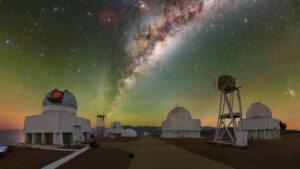
Research institutions collaborate with local conservation groups to conduct ongoing studies of sky brightness, atmospheric conditions, and the effects of light pollution on desert ecosystems. The Gamsberg mountain, located within the greater Namib region, hosts multiple astronomical observatories that take advantage of the area’s world-class viewing conditions.
Citizen science programs allow visitors to contribute to astronomical research by participating in sky brightness measurements, meteor shower observations, and satellite tracking projects. These activities provide tourists with deeper engagement in scientific research while contributing valuable data to international astronomy databases.
The Future of Dark Sky Tourism
The success of the NamibRand International Dark Sky Reserve has inspired similar conservation efforts across Africa and other developing regions. The area serves as a model for sustainable astrotourism that benefits local communities while preserving irreplaceable natural resources.
Economic studies show that dark sky tourism generates significant revenue for the region while requiring minimal infrastructure development that could threaten the very darkness that attracts visitors. This sustainable tourism model provides long-term economic incentives for maintaining strict light pollution controls.
As urban light pollution continues to spread globally, places like the Namib Desert become increasingly valuable as refuges where humans can experience the natural night sky that inspired our ancestors throughout history. The preservation of these dark sky sanctuaries represents a crucial link to humanity’s astronomical heritage and continues to provide inspiration for future generations of scientists and stargazers.
Key Takeaways
- World-Class Darkness: The NamibRand Nature Reserve in Namibia achieved Gold Tier International Dark Sky Reserve status in 2012, offering Bortle Class 1-2 sky conditions with virtually zero light pollution.
- Unique Southern Hemisphere Views: Visitors can observe celestial objects invisible from northern latitudes, including the Magellanic Clouds, Southern Cross, and the rarely-seen zodiacal light phenomenon.
- Scientific Value: Professional observatories and educational programs operated by the Namib Desert Environmental Education Trust provide both research opportunities and public astronomy education in one of Earth’s darkest accessible locations.
Learn More
- Atacama Desert Chile Becomes World’s Driest Astronomy Paradise – Discover Chile’s Atacama Desert the host of major international observatories in the driest place on Earth.
- Mauna Kea Hawaii High-Altitude Telescope Development Sparks Cultural Controversy – Explore the complex balance between advanced astronomy and indigenous cultural preservation on Hawaii’s sacred mountain.
- International Dark Sky Association Fights Light Pollution Through Global Conservation Efforts – Learn how worldwide organizations work to preserve natural darkness and establish protected dark sky areas.