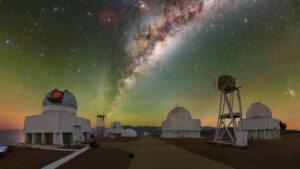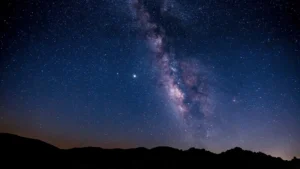
SAN PEDRO DE ATACAMA, CHILE – In the heart of Chile’s Desierto de Atacama (Atacama Desert), some of the world’s most powerful telescopes scan the universe from locations that offer the clearest and driest skies on Earth. This ancient desert hosts revolutionary observatories including ALMA (Atacama Large Millimeter/submillimeter Array) and the Paranal Observatory, which have transformed our understanding of the cosmos through groundbreaking discoveries.
The Atacama Desert stretches over 1,600 kilometers (1,000 miles) along Chile’s Pacific coast and covers 105,000 square kilometers (41,000 square miles). Scientists consider this region the driest non-polar desert on Earth, with some areas receiving less than 1 millimeter (0.04 inches) of rainfall annually. These extreme conditions, combined with high altitude and minimal atmospheric moisture, create perfect environments for astronomical observations.
Why This Desert Offers Perfect Skies
The Atacama Desert provides exceptional conditions for astronomy that cannot be found anywhere else on Earth. The region experiences more than 300 clear nights per year, with extremely low humidity levels that allow telescopes to detect faint signals from distant cosmic objects. The desert’s high altitude locations, ranging from 2,635 meters (8,645 feet) to over 5,000 meters (16,400 feet) above sea level, place observatories above most of Earth’s atmosphere.
The cold Humboldt Ocean Current flowing along Chile’s coast creates a permanent temperature inversion layer that traps moisture and clouds below 1,000 meters (3,280 feet) altitude. This natural phenomenon ensures that observatory sites remain above the cloud layer, providing unobstructed views of the sky throughout most of the year. The stable atmospheric conditions also minimize air turbulence that can blur telescope images.
The region’s extreme isolation contributes significantly to its value for astronomy. The nearest major cities are hundreds of kilometers away, ensuring minimal light pollution that could interfere with observations. Radio interference from electronic devices is also virtually nonexistent, making the area ideal for sensitive radio astronomy projects that detect weak signals from space.
ALMA: The World’s Highest Radio Observatory
The Gran Conjunto Milimétrico/submilimétrico de Atacama (Atacama Large Millimeter/submillimeter Array), known as ALMA, operates at 5,000 meters (16,400 feet) altitude on the Llano de Chajnantor plateau. The name “Chajnantor” comes from the indigenous Kunza language and means “the place of departure,” which seems fitting for an observatory that explores the distant universe.
ALMA consists of 66 high-precision radio antennas, most measuring 12 meters (40 feet) in diameter, that work together as a single giant telescope. This $1.5 billion international project represents collaboration between Europe, North America, and East Asia, making it the largest astronomical project ever undertaken. The antennas can be moved within a radius of 16 kilometers (10 miles) to adjust the telescope’s resolution and field of view.
The observatory specializes in detecting millimeter and submillimeter wavelengths of light, which come from some of the coldest objects in the universe. ALMA can observe through cosmic dust clouds that block visible light, allowing astronomers to study star and planet formation in unprecedented detail. The telescope has captured images of planetary systems being born and has provided insights into the early universe that would be impossible to obtain with optical telescopes.
Paranal Observatory Houses Very Large Telescope
Located 120 kilometers (75 miles) south of the port city of Antofagasta, the Paranal Observatory sits atop Cerro Paranal at 2,635 meters (8,645 feet) altitude. This facility, operated by the European Southern Observatory (ESO), houses the Telescopio Muy Grande (Very Large Telescope or VLT), one of the world’s most advanced optical telescopes.
The VLT consists of four individual telescopes, each equipped with mirrors measuring 8.2 meters (27 feet) in diameter. These telescopes, named Antu (Sun), Kueyen (Moon), Melipal (Southern Cross), and Yepun (Evening Star) in the indigenous Mapuche language, can operate independently or work together as an interferometer. When combined, they achieve resolution equivalent to a telescope with a 200-meter (650-foot) diameter mirror.
Each individual telescope can detect objects four billion times fainter than what human eyes can see. The facility has made groundbreaking discoveries including the first direct image of an exoplanet, tracking stars orbiting the supermassive black hole at our galaxy’s center, and measuring the mass of distant planets. The VLT has contributed to more than one peer-reviewed scientific paper per day since it began operations in 1998.
Extreme Operating Conditions Challenge Scientists
Working at these high-altitude observatories presents significant challenges for scientists and engineers. At ALMA’s 5,000-meter altitude, oxygen levels are only 60% of those at sea level, requiring staff to use supplemental oxygen and limiting work shifts to protect against altitude sickness. The extreme environment becomes even more challenging during rare weather events, such as the historic snowfall that recently covered ALMA’s antennas.
Temperature variations can be extreme, with daytime temperatures exceeding 40°C (104°F) and nighttime temperatures dropping below freezing. During winter months at high altitudes, temperatures can reach -12°C (10°F) with wind chill making conditions feel like -28°C (-18°F). These conditions require specialized equipment design and careful maintenance procedures to keep telescopes operating properly.
The remoteness of these sites means everything needed for operations must be transported over difficult terrain. The Paranal Observatory requires 60,000 liters (15,850 gallons) of water daily, all delivered by truck from Antofagasta. Despite these challenges, the exceptional astronomical conditions make the logistical difficulties worthwhile for advancing scientific knowledge.
Revolutionary Discoveries Transform Astronomy
The observatories in the Atacama Desert have produced discoveries that have revolutionized our understanding of the universe. ALMA has observed the formation of planets around young stars, providing direct evidence of how planetary systems develop. The telescope has also detected complex organic molecules in space, offering clues about the chemical ingredients that could lead to life.
The VLT at Paranal has captured the first direct spectrum of an exoplanet’s atmosphere and measured the mass of planets orbiting other stars. The telescope discovered R136a1, the most massive star known, which has 265 times the mass of our Sun. These observations help scientists understand stellar evolution and the life cycles of massive stars.
Both observatories have contributed to studies of dark matter and dark energy, mysterious components that make up most of the universe but remain poorly understood. The high-quality images and data from these telescopes provide crucial information for testing theories about cosmic structure and the universe’s expansion.
Technological Innovations Enable Precision
The extreme precision required for these observations has driven development of cutting-edge technologies. ALMA’s antennas must work together with timing accuracy of less than one thousandth of a millimeter over distances of many kilometers. This requires sophisticated computer systems that constantly adjust for Earth’s rotation, atmospheric changes, and minute mechanical variations.
The VLT uses adaptive optics systems that correct for atmospheric turbulence in real-time by adjusting mirror shapes hundreds of times per second. This technology allows ground-based telescopes to achieve image quality that rivals space telescopes, while being much larger and less expensive to build and maintain.
Each VLT unit telescope weighs as much as a fully loaded jumbo jet but is so precisely balanced on special bearings that astronomers can move these massive instruments by hand. The engineering required to achieve this level of precision while maintaining stability in the desert environment represents remarkable technological achievement.
Tourist Opportunities Bring Science to Public
Despite their remote locations and scientific focus, several observatories in the Atacama offer public tours that allow visitors to experience world-class astronomy facilities. The Paranal Observatory conducts guided tours on Saturdays, showing visitors the VLT telescopes and explaining their scientific missions. These tours must be booked in advance due to high demand and the limited access to the remote site.
ALMA offers weekend tours to their Operations Support Facility at 2,900 meters (9,500 feet) altitude, though visitors cannot access the high-altitude antenna site for safety reasons. The tour includes presentations about radio astronomy and opportunities to see the control rooms where astronomers operate the world’s most powerful radio telescope.
The nearby town of San Pedro de Atacama has become a hub for astronomy tourism, with numerous companies offering stargazing tours and visits to smaller observatories designed for public education. These experiences allow visitors to observe the same spectacular skies that make the region ideal for professional astronomy, often using high-quality telescopes under expert guidance.
Environmental Protection Becomes Critical Priority
The success of astronomy in the Atacama Desert has made protecting the region’s unique environmental conditions a critical priority. Chile has enacted some of the world’s strictest light pollution regulations to preserve the dark skies that make these observations possible. These laws control outdoor lighting design, requiring special fixtures that minimize upward light emission.
The regulations extend beyond simple light pollution to include protection from radio interference and atmospheric contamination. Mining operations and other industrial activities near observatory sites must follow strict guidelines to prevent interference with sensitive astronomical observations. Chile recognizes that its clear skies represent a valuable natural resource that requires active protection.
Climate change poses emerging challenges to observatory operations, with some studies showing increased atmospheric turbulence and temperature changes that could affect observation quality. Scientists are monitoring these trends carefully and developing adaptation strategies to maintain the region’s value for astronomical research.
Future Projects Expand Cosmic Exploration
The success of current observatories has led to plans for even more ambitious projects in the Atacama Desert. The Extremely Large Telescope (ELT), currently under construction at Cerro Armazones near Paranal, will have a mirror 39 meters (128 feet) in diameter when completed in 2028. This telescope will be powerful enough to directly image Earth-like planets around nearby stars.
The Vera C. Rubin Observatory, expected to begin operations in 2025, will conduct a 10-year survey of the southern sky to study dark matter, catalog solar system objects, and map the Milky Way galaxy. These next-generation facilities will continue the Atacama’s role as the world’s premier location for ground-based astronomy.
The region’s importance for astronomy extends beyond individual telescopes to its role as a testing ground for space exploration technologies. NASA has used the Atacama’s Mars-like landscape to test rovers and other equipment destined for planetary missions, taking advantage of the desert’s similarities to extraterrestrial environments.
Economic Impact Benefits Local Communities
The international astronomy projects in the Atacama Desert have brought significant economic benefits to northern Chile. The observatories employ hundreds of scientists, engineers, and support staff, creating high-paying jobs in a previously underdeveloped region. Local communities have also benefited from improved infrastructure, including roads, communications, and utilities needed to support the observatories.
Astronomy tourism has become an important economic sector, with visitors from around the world traveling to experience the region’s dark skies and visit world-class observatories. Hotels, restaurants, and tour companies in San Pedro de Atacama and other nearby towns have developed specialized services for astronomy enthusiasts, creating additional employment opportunities.
The presence of cutting-edge technology and international scientific collaboration has also made northern Chile a center for technical education and innovation. Universities and research institutions have established programs to train local students in astronomy and engineering, building human capital that supports continued scientific development.
Global Collaboration Advances Human Knowledge
The observatories in the Atacama Desert represent unprecedented international cooperation in scientific research. ALMA involves 22 countries across three continents, while the VLT brings together 16 European nations in pursuit of astronomical knowledge. These collaborations demonstrate how shared scientific goals can unite nations in peaceful cooperation.
The discoveries made possible by the Atacama’s exceptional conditions benefit all humanity by advancing our understanding of the universe and our place within it. From insights into planet formation that help us understand Earth’s history to observations of distant galaxies that reveal cosmic evolution, these telescopes provide knowledge that belongs to everyone.
As the world’s premier location for ground-based astronomy, the Atacama Desert continues to push the boundaries of human knowledge about the cosmos. The combination of natural advantages and technological innovation makes this region irreplaceable for understanding the universe and searching for life beyond our planet.
Key Takeaways
- Ideal Natural Conditions: The Desierto de Atacama provides the world’s driest and clearest atmospheric conditions at high altitudes, with over 300 clear nights annually and minimal atmospheric moisture interference for astronomical observations.
- World-Leading Observatories: ALMA at 5,000 meters (16,400 feet) on Llano de Chajnantor operates as the highest radio telescope array, while Paranal Observatory at 2,635 meters (8,645 feet) houses the Very Large Telescope, one of the most advanced optical telescopes.
- Revolutionary Scientific Impact: These facilities have produced groundbreaking discoveries including first direct exoplanet images, observations of planetary formation, and studies of supermassive black holes, contributing to over one peer-reviewed paper daily since operations began.
Learn More
- Mauna Kea Hawaii Astronomy Observatories Face Indigenous Cultural Controversy – Explore how Hawaii’s sacred mountain hosts world-class telescopes amid ongoing cultural and environmental concerns.
- European Southern Observatory Builds Extremely Large Telescope in Chilean Andes – Discover how ESO’s next-generation 39-meter telescope will revolutionize astronomy from Cerro Armazones near Paranal.
- Radio Astronomy Breakthrough Discoveries Transform Understanding Through ALMA Telescope – Learn how ALMA’s revolutionary radio observations reveal hidden cosmic processes invisible to optical telescopes.