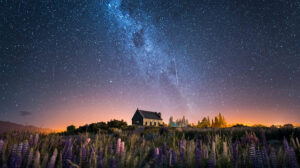
LAKE TEKAPO, NEW ZEALAND – High in New Zealand’s Southern Alps, the Aoraki Mackenzie International Dark Sky Reserve protects some of the darkest skies in the Southern Hemisphere. Covering 4,367 square kilometers (1,686 square miles), this massive reserve was designated by the International Dark-Sky Association in June 2012 as the world’s largest Dark Sky Reserve and the first of its kind in the Southern Hemisphere.
The reserve encompasses Aoraki/Mount Cook National Park and the Mackenzie Basin in New Zealand’s South Island, creating a protected zone where Bortle Scale 1-2 conditions allow visitors to see celestial wonders invisible to most of the world’s population. At its heart sits the University of Canterbury’s Mount John Observatory at 1,029 meters (3,376 feet) elevation, serving as New Zealand’s premier astronomical research facility and a world-class destination for stargazing experiences.
Sacred Mountain Connects Earth and Sky
The reserve takes its name from Aoraki, New Zealand’s highest mountain at 3,724 meters (12,218 feet), which holds profound spiritual significance for the indigenous Māori people. According to Ngāi Tahu tradition, Aoraki was a young man who, along with his three brothers, were sons of Rakinui (Sky Father). During their voyage around Papatūānuku (Earth Mother), their waka (canoe) became stranded on a reef and tilted, forcing them to climb onto the high side where the freezing south wind turned them to stone, creating the Southern Alps.
The name “Aoraki” traditionally means “cloud piercer” in the Māori language, reflecting the mountain’s tendency to penetrate the clouds that frequently shroud the Southern Alps. To Ngāi Tahu iwi (tribe), Aoraki represents their most sacred ancestor, from whom they descend and who provides their sense of communal identity and spiritual connection to the land. The mountain’s Tōpuni status recognizes it as a symbol of Māori cultural authority and spiritual significance.
The night sky has played a critical role in Māori culture since their ancestors first navigated to New Zealand using celestial navigation techniques. Traditional Māori astronomy, known as tātai aroraki, integrated star knowledge into daily life, seasonal activities, and spiritual practices. The Dark Sky Reserve honors this heritage by protecting the natural darkness that has guided Māori for centuries and continues to connect them with their ancestors.
Perfect Geography Creates Exceptional Darkness
The Mackenzie Basin’s unique geography creates ideal conditions for astronomical observations. This high-altitude desert basin sits between mountain ranges that block light pollution from New Zealand’s main population centers. The Southern Alps rise to the west and south, while the Two Thumb Range provides protection from the east, creating a natural bowl that concentrates the darkness.
The region experiences exceptional atmospheric conditions with low humidity, minimal cloud cover, and stable air currents. Approximately 68% of nights are suitable for astronomical observations, with many offering photometric quality conditions perfect for sensitive scientific measurements. The high altitude and dry climate mean less atmospheric interference, allowing telescopes to detect fainter objects and achieve sharper images.
Light pollution controls implemented in the early 1980s have maintained the area’s exceptional darkness. The Mackenzie District Council’s lighting bylaws require all outdoor lighting to be shielded, use warm-colored bulbs, and direct light downward rather than into the sky. These regulations protect both the observatory’s scientific mission and the area’s value as a stargazing destination.
Mount John Observatory Leads Southern Sky Research
Established in 1965, the University of Canterbury Mount John Observatory serves as New Zealand’s premier astronomical research facility. The observatory operates five major telescopes ranging from 0.4 to 1.8 meters in diameter, with the largest being the MOA (Microlensing Observations in Astrophysics) telescope dedicated to discovering planets around distant stars.
The facility has made significant contributions to astronomical research, including the discovery of some of the smallest exoplanets known outside our solar system. In 2008, researchers using the MOA telescope reported finding what was then the smallest planet discovered beyond our solar system, demonstrating the observatory’s world-class capabilities for cutting-edge research.
The McLellan telescope, named after Alister McLellan who helped establish the observatory, operates as a 0.61-meter reflecting telescope used for photometric observations. Another 0.61-meter telescope runs exclusively for CCD photometry and has been upgraded for robotic operation as part of the American Association of Variable Star Observers’ Robotic Telescope Network, marking their first Southern Hemisphere installation.
Southern Hemisphere Reveals Unique Celestial Treasures
The Aoraki Mackenzie Dark Sky Reserve offers access to celestial objects and phenomena visible only from the Southern Hemisphere. Visitors can observe the Large and Small Magellanic Clouds, satellite galaxies of the Milky Way that appear as bright, cloud-like patches in the night sky. These galaxies are completely invisible from most northern hemisphere locations.
The Southern Cross constellation, one of the most recognizable star patterns in the southern sky, serves as a natural compass for navigation. Its closest star lies 88.6 light-years away, yet appears brilliant in the reserve’s dark skies. The constellation holds special significance in Māori culture and features prominently in traditional navigation and seasonal calendars.
The center of the Milky Way galaxy passes directly overhead during winter months, providing spectacular views of dense star fields, colorful nebulae, and dark dust lanes that are much less prominent when viewed from northern latitudes. The zodiacal light, a faint triangular glow extending from the horizon, becomes visible as a result of sunlight reflecting off cosmic dust particles throughout the solar system.
Gold Tier Recognition Confirms World-Class Status
The Aoraki Mackenzie International Dark Sky Reserve earned Gold Tier designation, the highest level available from the International Dark-Sky Association. As of 2013, only two locations worldwide had achieved this prestigious status: Aoraki Mackenzie and the NamibRand Nature Reserve in Namibia. This recognition places the reserve among the absolute darkest accessible locations on Earth.
The Gold Tier designation requires demonstrating exceptional natural darkness, comprehensive lighting protection measures, and strong community commitment to dark sky preservation. The reserve meets all these criteria through its remote location, strict lighting controls, and active education programs that promote understanding of dark sky importance.
Sky quality measurements consistently show Bortle Scale 2 readings throughout most of the reserve, with some areas approaching Bortle Scale 1 conditions during optimal weather. These measurements place the reserve’s darkness on par with the most remote locations on Earth, yet it remains accessible to visitors through established tourism infrastructure.
World-Class Stargazing
The Dark Sky Project, formerly known as Earth & Sky, operates professional stargazing tours that take advantage of the reserve’s exceptional conditions. Their Summit Experience at Mount John Observatory provides visitors with access to research-grade telescopes and expert astronomical guidance in a setting surrounded by professional observatory domes.
Tours include both naked-eye stargazing guided by laser pointers and telescope observations through powerful instruments including 16-inch telescopes housed in private observatory domes. Visitors can observe planets, star clusters, distant galaxies, and nebulae while learning about both Western and Māori astronomical traditions from knowledgeable guides.
The experience runs year-round, though winter months from May through August typically offer the clearest skies and most stable atmospheric conditions. Summer provides different viewing opportunities with access to different portions of the Milky Way and seasonal celestial events. Tours accommodate various skill levels from complete beginners to experienced amateur astronomers.
Multiple Viewing Locations Serve Different Needs
Lake Tekapo serves as the main hub for stargazing activities, offering various accommodation options and easy access to Mount John Observatory. The town’s strict lighting controls and tourism infrastructure make it an ideal base for exploring the reserve’s astronomical offerings.
Mount Cook Village, located within Aoraki/Mount Cook National Park, provides an alternative stargazing destination with dramatic alpine scenery as a backdrop. The village offers its own astronomy programs at lower costs than Mount John Observatory, though with slightly less sophisticated equipment and guidance.
The Pukaki Observatory and Wine Cellar combines stargazing with culinary experiences, offering wine and food pairings alongside telescope observations. Located at Mount Cook Lakeside Retreat, this venue provides a more relaxed approach to astronomy appreciation in completely dark surroundings.
Seasonal Considerations Affect Viewing Quality
Winter months from June through August provide the best stargazing conditions with the longest nights, clearest skies, and most stable weather patterns. During winter, the center of the Milky Way passes overhead, providing spectacular views of the galactic center’s dense star fields and colorful nebulae.
Summer months from December through February offer warmer weather and different astronomical targets, though atmospheric conditions may be less stable due to increased thermal activity. Summer visitors can observe different portions of the sky and experience unique seasonal phenomena like extended twilight periods at this southern latitude.
Moon phases significantly impact viewing conditions, with new moon periods providing the darkest skies for observing faint objects like galaxies and nebulae. However, the reserve’s exceptional darkness means quality stargazing remains possible during most lunar phases, with only the brightest full moon nights significantly impacting faint object visibility.
Tourism Balances Access with Protection
The reserve’s designation has created a thriving astrotourism industry that provides economic benefits while funding continued dark sky protection efforts. Professional tour operators work within strict guidelines to minimize light pollution and educate visitors about the importance of preserving natural darkness.
Tourism revenue supports ongoing lighting control measures, public education programs, and monitoring efforts that ensure the reserve maintains its world-class sky quality. The economic value of dark skies provides strong incentives for local communities to maintain strict lighting standards and resist development that could threaten the area’s darkness.
Visitor education programs teach about light pollution impacts on wildlife, human health, and astronomical observations. These programs help create ambassadors for dark sky protection who return to their home communities with increased awareness of lighting issues and practical solutions for reducing light pollution.
Scientific Research Continues Important Work
Mount John Observatory continues its important role in international astronomical research through collaborations with institutions worldwide. The Japanese/New Zealand MOA collaboration has made significant contributions to exoplanet research, while other telescopes conduct variable star studies, asteroid observations, and atmospheric research.
The observatory’s southern hemisphere location provides access to sky regions invisible from most major astronomical facilities in North America and Europe. This unique position allows researchers to conduct complementary observations of celestial objects and phenomena, contributing to global astronomical knowledge.
Research programs include participation in international networks for asteroid detection, variable star monitoring, and exoplanet searches. The observatory’s high-quality instruments and exceptional sky conditions make it a valuable contributor to multiple international research collaborations.
Future Challenges Require Ongoing Vigilance
Despite its protected status, the reserve faces growing challenges from increasing light pollution as New Zealand’s population grows and tourism expands. Urban development in distant cities like Christchurch can create light domes visible even from the reserve’s remote location.
Climate change poses potential challenges to the area’s exceptional atmospheric conditions. Changes in weather patterns could affect the frequency of clear nights and the stability of atmospheric conditions that make the region ideal for astronomical observations.
The growth of satellite constellations presents a new form of pollution that affects astronomical observations worldwide. These bright moving objects can interfere with sensitive observations and astrophotography, requiring ongoing adaptation of observing techniques and advocacy for responsible satellite design.
Global Model for Dark Sky Conservation
The Aoraki Mackenzie International Dark Sky Reserve serves as a model for dark sky conservation efforts worldwide. The successful combination of scientific research, tourism development, and cultural preservation demonstrates how communities can balance economic development with environmental protection.
The reserve’s integration of Māori cultural values with modern astronomy creates a unique approach to science education and cultural preservation. This model shows how indigenous knowledge systems can complement and enrich modern scientific understanding of the cosmos.
International recognition of the reserve has helped raise global awareness of light pollution issues and the value of protecting natural darkness. The success of the Aoraki Mackenzie reserve encourages similar efforts in other regions with suitable conditions and community support for dark sky protection.
Inspiring Wonder and Scientific Curiosity
Visitors to the Aoraki Mackenzie Dark Sky Reserve often describe their experience as transformative, providing their first clear view of the Milky Way and a direct connection to the cosmos that urban light pollution typically obscures. These experiences inspire curiosity about astronomy and science while fostering appreciation for environmental protection.
The combination of cutting-edge research facilities, professional tourism operations, and cultural education creates a unique destination that serves multiple purposes: advancing scientific knowledge, supporting local communities, preserving cultural heritage, and inspiring public interest in astronomy and conservation.
As one of the last places on Earth where humans can experience truly natural darkness, the Aoraki Mackenzie International Dark Sky Reserve represents both an achievement in conservation and a reminder of what we stand to lose if light pollution continues to spread unchecked across our planet.
Key Takeaways
- World’s Largest Dark Sky Reserve: The Aoraki Mackenzie International Dark Sky Reserve covers 4,367 square kilometers (1,686 square miles) with Gold Tier designation, representing the world’s largest protected dark sky area when designated in 2012.
- Premier Southern Hemisphere Astronomy: Mount John Observatory at 1,029 meters (3,376 feet) elevation serves as New Zealand’s leading research facility, offering Bortle Scale 1-2 conditions for viewing Southern Hemisphere celestial objects invisible from northern latitudes.
- Cultural Integration: The reserve honors Māori astronomical traditions and the sacred significance of Aoraki (Mount Cook), demonstrating how indigenous knowledge systems can complement modern scientific research and dark sky conservation efforts.
Learn More
- Kerry International Dark Sky Reserve Ireland Protects Wild Atlantic Way Stargazing – Discover how Ireland’s first Dark Sky Reserve preserves traditional Celtic astronomy knowledge along the rugged Atlantic coastline.
- Mont-Mégantic Canada Becomes World’s First International Dark Sky Reserve – Explore the pioneering Quebec reserve that established the global Dark Sky Reserve model and continues leading dark sky education efforts.
- Southern Hemisphere Astronomy Reveals Unique Celestial Objects and Phenomena – Learn about the distinctive astronomical features visible only from southern latitudes, including the Magellanic Clouds and southern Milky Way center.